
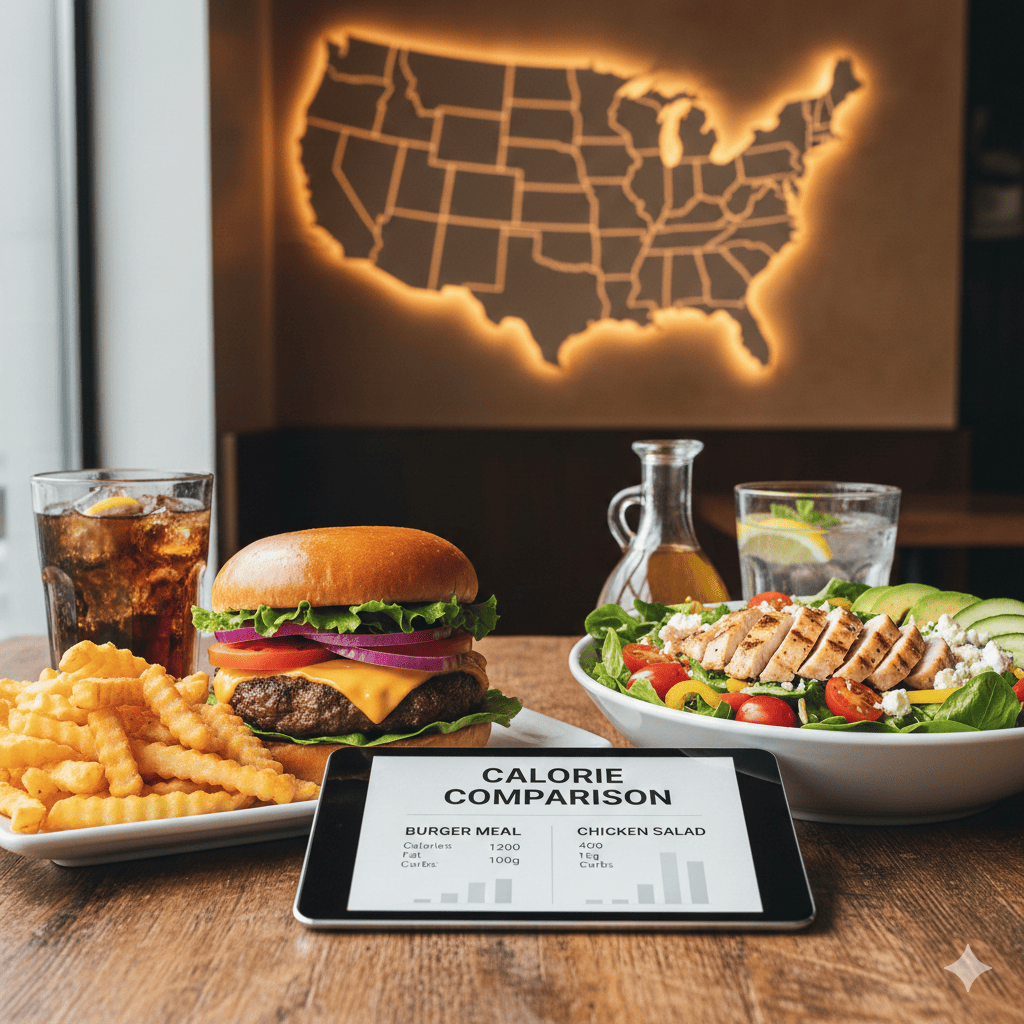
Health Halo Effect: 5 “Healthy” Salads With More Calories Than a Burger
In America’s quest for healthier eating, few words carry more psychological power than “salad.” This simple term triggers what behavioral economists call the “health halo”—a cognitive bias where we perceive anything labeled “salad” as automatically nutritious, low-calorie, and virtuous. But in 2025’s restaurant reality, this halo often blinds us to nutritional truths more shocking than any burger’s confession.
The Calorie Catastrophes: Consider these actual menu items:
Applebee’s Oriental Chicken Salad: 1,400 calories, 88g fat
Chili’s Quesadilla Explosion Salad: 1,430 calories, 99g fat
Cheesecake Factory’s Caesar Salad: 1,190 calories, 103g fat
Meanwhile:
McDonald’s Big Mac: 590 calories, 34g fat
Wendy’s Dave’s Single: 570 calories, 32g fat
Five Guys Cheeseburger: 840 calories, 55g fat
The salads contain 500-800 more calories than the burgers they’re supposedly “healthier” than.
The Psychology of Green: Simply adding lettuce to a dish triggers health perceptions. Research shows people estimate salad calories 35% lower than identical meals without greens. Restaurants exploit this by taking high-calorie ingredients (fried chicken, creamy dressings, cheese, croutons, candied nuts) and adding token greens to claim “salad” status.
The Dressing Deception: Two tablespoons of typical restaurant dressing add 150-300 calories. But restaurant salads often arrive pre-dressed with 4-6 tablespoons—adding 300-900 hidden calories. Creamy dressings (ranch, Caesar, blue cheese) are particularly problematic, often containing more calories per ounce than the salad ingredients they coat.
The Topping Trap: Restaurants load salads with calorie-dense additions:
Croutons (1 cup): 120 calories
Candied nuts (¼ cup): 200+ calories
Cheese (½ cup shredded): 220 calories
Dried fruit (¼ cup): 100 calories
Bacon bits (2 tablespoons): 70 calories
A “salad” becomes a collection of high-calorie toppings with lettuce as mere bedding.
The Protein Problem: Salad proteins often come fried (crispy chicken, fried shrimp, breaded tofu) or drenched in high-calorie marinades. That “grilled chicken” might be basted in oil, while “blackened” fish might mean “coated in butter and spices.”
Our Calorie Comparison Tool shatters the health halo instantly. By comparing salads to burgers, sandwiches, and other “indulgent” options, you see reality beyond labels. You might discover that the Cobb Salad you always order “to be good” contains more calories than the bacon cheeseburger you’ve been denying yourself.
The Restaurant Economics: Salads command premium prices despite often containing cheaper ingredients than burgers. That $16 salad might cost the restaurant $3 to make, while the $12 burger costs $4. The health halo allows massive profit margins while making customers feel virtuous about their overpayment.
The “Salad as License” Phenomenon: Behavioral studies show people who order salads:
Are 25% more likely to add dessert
Choose higher-calorie drinks
Underestimate their total meal calories by 40%
The salad becomes psychological permission for indulgence elsewhere in the meal.
Identifying True Salads vs. Salad Impostors:
Salad Impostors (Avoid):
Contain fried proteins
Feature creamy dressings applied in kitchen
Include candied nuts, croutons, excessive cheese
Have “crispy,” “crunchy,” or “loaded” in the name
True Salads (Consider):
Feature grilled, baked, or poached proteins
Come with dressing on the side
Emphasize vegetables over toppings
Have “garden,” “green,” or “house” in simple descriptions
The Customization Solution: Transform any salad impostor into a true healthy option:
“Dressing on the side, please” (use 1-2 tablespoons max)
“No croutons/candied nuts” (save 100-300 calories)
“Grilled instead of fried protein” (save 150-300 calories)
“Extra vegetables instead of cheese” (save 100 calories, gain nutrients)
“Light on the cheese” (save 50-100 calories)
The 2026 Mindset Shift: We must retire the simplistic “salad = healthy, burger = unhealthy” dichotomy. Nutritional value depends on ingredients and preparation, not category labels. A burger with lean beef, vegetables, and whole grain bun can be healthier than a salad drowning in dressing and fried toppings.
Practical Strategy: Before ordering, ask yourself:
What are the actual ingredients?
How is it prepared?
What comes standard vs. what can be modified?
How does it compare to other menu options using objective data?
The Empowerment Moment: When you use comparison tools to see past marketing labels, you reclaim food choices from psychological manipulation. You recognize that “salad” is just a word—one that can describe anything from nutrient-packed greens to calorie-bomb constructions.
As we approach 2026, intelligent eating means looking beyond category names to ingredient reality. It means recognizing that sometimes the burger is the smarter choice, and sometimes the salad needs serious modification. With awareness and tools, you can enjoy both while making choices that truly support your health goals.
The health halo isn’t inherently bad—it reflects our desire for wellness. But we must ensure it illuminates rather than obscures. By comparing before choosing, you ensure your “healthy” choice is genuinely healthy, not just linguistically virtuous.
🇺🇸 USA Food Calorie Comparator
Think before you order! Your health is more important than your taste buds! Eating more 'empty' calories can lead to accumulation of unnecessary fat in your body and invite obesity and many more diseases!. Be aware of the calorific and nutritional values of the foods which you are ordering! Compare calories between popular restaurant items in USA. Make informed choices at McDonald's, Burger King, Wendy's, Taco Bell, Chick-fil-A, Subway and more! Use our simple tool to make comparisons!
Item 1
Protein: g
Carbs: g
Fat: g
Item 2
Protein: g
Carbs: g
Fat: g
🏆 Comparison Result
Tip: Choosing the lower-calorie option regularly can help with weight management.