
usa-food-calorie-comparator
The Silent Epidemic: Why Every Food Choice Matters in America’s Health Crisis
The American Paradox: Abundance and Malnutrition
Read Article
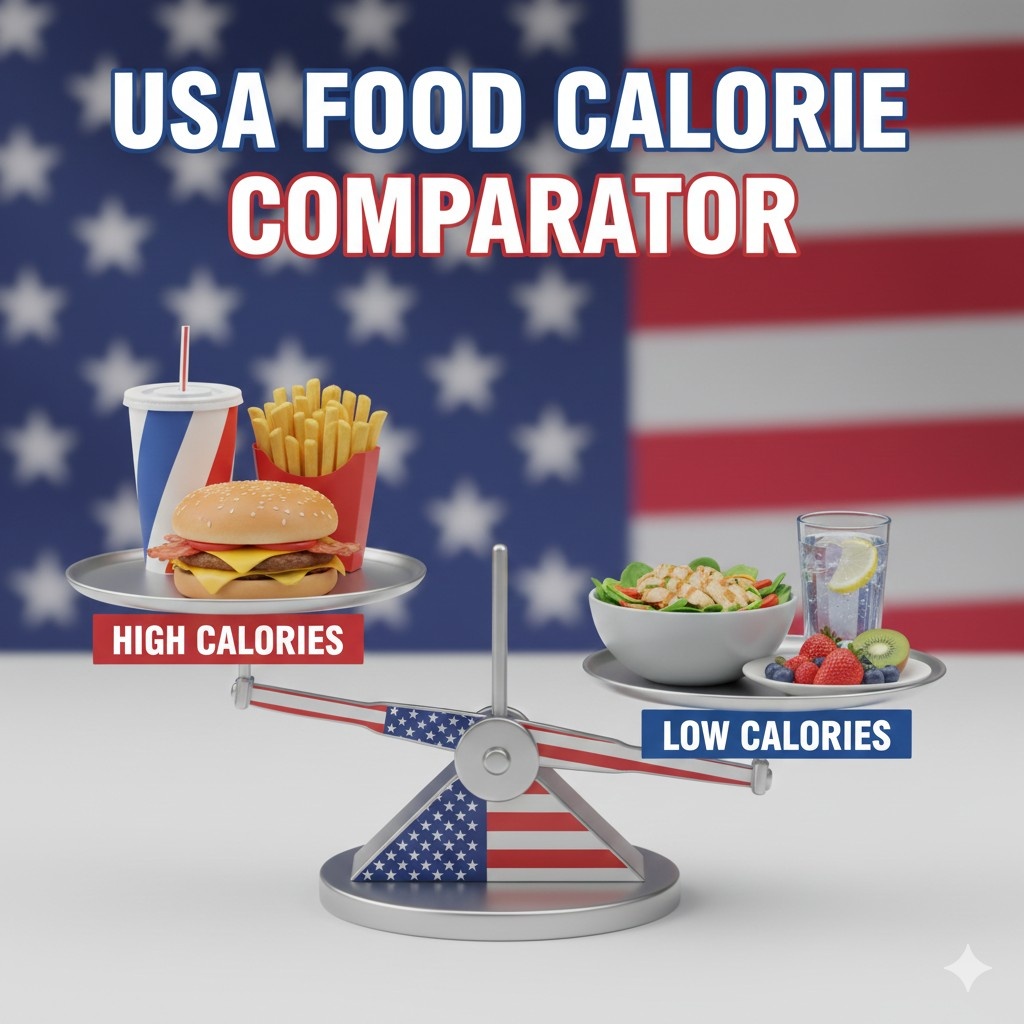
🇺🇸 USA Food Calorie Comparator
Think before you order! Your health is more important than your taste buds! Eating more 'empty' calories can lead to accumulation of unnecessary fat in your body and invite obesity and many more diseases!. Be aware of the calorific and nutritional values of the foods which you are ordering! Compare calories between popular restaurant items in USA. Make informed choices at McDonald's, Burger King, Wendy's, Taco Bell, Chick-fil-A, Subway and more! Use our simple tool to make comparisons!
Item 1
Protein: g
Carbs: g
Fat: g
Item 2
Protein: g
Carbs: g
Fat: g
🏆 Comparison Result
Tip: Choosing the lower-calorie option regularly can help with weight management.
The Silent Epidemic: Why Every Food Choice Matters in America’s Health Crisis
The American Paradox: Abundance and Malnutrition
In a nation where food is more abundant and accessible than ever before in human history, Americans face a startling paradox: we are simultaneously overfed and undernourished. The United States spends more on healthcare than any other developed country—approximately $4.3 trillion annually—yet ranks alarmingly low in life expectancy and overall health outcomes among wealthy nations. The root cause of this contradiction often begins with what we choose to put on our plates, particularly when dining out or ordering takeout.
The average American consumes restaurant meals 4-5 times per week, with fast food accounting for a significant portion of these meals. While convenient and often satisfying to our taste buds, these choices carry hidden costs that extend far beyond the price on the receipt. Each meal represents an opportunity—either to fuel our bodies with nutrients that support health or to introduce substances that undermine it.
The Mathematics of Moderation: Small Choices, Big Consequences
Consider this sobering reality: consuming just 100 extra calories per day—roughly equivalent to two tablespoons of ketchup or a single cookie—can lead to a 10-pound weight gain over a year. Now multiply that by the hundreds of “empty calories” often found in restaurant meals, and you begin to understand why obesity affects over 42% of American adults. The Centers for Disease Control and Prevention reports that obesity-related conditions including heart disease, stroke, type 2 diabetes, and certain types of cancer are among the leading causes of preventable, premature death.
What makes this particularly tragic is that most people don’t realize they’re making unhealthy choices. Restaurant portions have ballooned over the decades—today’s average cheeseburger contains 250 more calories than its 1970s counterpart, and soda portions have tripled in size. The “value meal” mentality encourages overconsumption, while sophisticated food science creates products deliberately engineered to override our natural satiety signals, making us want to eat more than we need.
The Blueprint for Health: Understanding Ideal Parameters
So what should we be aiming for? Health professionals emphasize several key parameters:
Body Mass Index (BMI): Ideally between 18.5 and 24.9. Currently, only about 30% of Americans fall within this healthy range.
Blood Pressure: Below 120/80 mmHg. Nearly half of American adults have hypertension, significantly increasing stroke and heart attack risk.
Blood Sugar: Fasting glucose under 100 mg/dL. Over 38 million Americans have diabetes, with another 96 million prediabetic—that’s 1 in 3 adults.
Cholesterol: LDL (“bad” cholesterol) below 100 mg/dL. High cholesterol affects nearly 40% of American adults.
Waist Circumference: Less than 35 inches for women, 40 inches for men. Abdominal fat is particularly dangerous, linked to metabolic syndrome.
The reality is stark: most Americans fail to meet these basic health benchmarks. The consequences aren’t just statistical—they’re personal, affecting quality of life, healthcare costs, and longevity.
The Restaurant Dilemma: Navigating a Minefield of Hidden Calories
Restaurant meals present unique challenges. Studies show that people consume 20-40% more calories when eating out compared to home-cooked meals. The reasons are multifactorial: larger portions, higher fat and sugar content, “free” bread or chips before meals, and sugary beverages that add hundreds of empty calories.
Take a typical restaurant meal: a cheeseburger (750 calories), medium fries (400 calories), and a regular soda (250 calories) totals approximately 1,400 calories—that’s nearly 70% of the daily recommended intake for an average adult in a single sitting! When you consider that the average American eats out 4-5 times weekly, the cumulative effect becomes staggering.
Yet here’s the empowering truth: knowledge changes everything. When you understand that choosing grilled chicken over fried saves 200 calories, or that opting for water instead of soda eliminates 250 calories, you regain control. These aren’t deprivations—they’re smart swaps that allow you to enjoy restaurant meals while protecting your health.
The Ripple Effect: How Individual Choices Shape Collective Health
Every informed food choice creates a ripple effect. When you choose healthier options, you’re not just improving your own health metrics—you’re influencing restaurant offerings (as businesses respond to consumer demand), inspiring friends and family through your example, and reducing the burden on our healthcare system.
Consider the transformation possible through simple awareness:
Switching from a bacon cheeseburger to a regular hamburger twice weekly could prevent 5 pounds of weight gain annually
Choosing salad instead of fries with your meal could reduce heart disease risk by improving cholesterol levels
Opting for water over sugary drinks significantly lowers diabetes risk
A New Relationship with Food: Beyond Restriction to Empowerment
The goal isn’t to eliminate restaurant meals or live in a state of perpetual deprivation. Rather, it’s about developing a new relationship with food—one based on awareness rather than autopilot, on nourishment rather than mere consumption.
Our tools provide the missing piece: immediate, accessible information that transforms guesswork into informed decision-making. By comparing menu items before you order, you shift from passive consumer to active participant in your health journey. You learn that a Chicken McChicken has 190 fewer calories than a Big Mac, that a Whopper Jr. saves you 320 calories compared to a regular Whopper, and that swapping fries for a side salad can save over 300 calories.
This knowledge is power—the power to enjoy social meals without sacrificing health, to maintain weight without extreme diets, and to invest in long-term wellbeing through daily choices. In a culture that often equates “more” with “better,” we’re reminded that sometimes the wisest choice is different, not larger; nutritious, not just tasty; conscious, not automatic.
The Path Forward: One Meal at a Time
Health transformation doesn’t require perfection—it requires persistence. It’s not about never enjoying your favorite foods, but about understanding their impact and making balanced choices. Each meal is a new opportunity, each restaurant visit a chance to practice awareness.
As you use our comparison tools, remember: you’re not just counting calories—you’re claiming control. You’re not just choosing between menu items—you’re choosing between different health futures. In a nation facing a health crisis of unprecedented scale, the most revolutionary act may be the simplest: knowing what you’re eating, and choosing accordingly.
The journey to better health begins not in a doctor’s office or a pharmacy, but in the moments before we say, “I’ll have what he’s having.” It begins with pausing, comparing, and choosing—with understanding that every bite is either building health or borrowing from it. And in that simple pause lies the power to change not just our meals, but our lives.
⚖️ BMI Calculator
Calculate Your Body Mass Index - A Standard Screening Tool for Weight Categories
Height
Weight
📊 Your BMI Results
📖 What is BMI?
Body Mass Index (BMI) is a simple calculation using a person's height and weight. The formula is BMI = kg/m² where kg is a person's weight in kilograms and m² is their height in meters squared.
⚕️ BMI Categories for Adults (WHO Standard)
- Underweight: BMI less than 18.5
- Normal weight: BMI 18.5 to 24.9
- Overweight: BMI 25 to 29.9
- Obesity (Class I): BMI 30 to 34.9
- Obesity (Class II): BMI 35 to 39.9
- Obesity (Class III): BMI 40 or greater
⚠️ Limitations of BMI
BMI has some limitations:
- Doesn't distinguish between muscle and fat
- May overestimate body fat in athletes and muscular individuals
- May underestimate body fat in older persons and those who have lost muscle
- Doesn't account for body fat distribution
- Not suitable for children, pregnant women, or some ethnic groups
Note: BMI is a screening tool, not a diagnostic tool. Consult a healthcare provider for a comprehensive health assessment.
Recent Posts
- Child and Teen BMI Calculator
- BMI Calculator
- BMR calculator
- For Parents: Navigating Kids’ Menus Without the Sugar Rush
- USA Food Calorie Comparator
- The Simple Math of Weight Maintenance: How One Restaurant Swap Can Save Your Waistline
- Eating Out on Keto/Low-Carb: A Survival Guide for Restaurant Lovers
- Health Halo Effect: 5 “Healthy” Salads With More Calories Than a Burger
- Plant-Based Fast Food: Healthy Innovation or Marketing Hype?
- The Psychology of Restaurant Portions: Why We Overeat Without Realizing It
- How to Navigate Restaurant Menus When You Have Diabetes
- The Shocking Calorie Differences in America’s Favorite ‘Comfort Foods’
- Why Counting Calories Still Matters in 2025 (Despite What Influencers Say)
- Fast Food Survival Guide: How to Eat Out Without Derailing Your Diet